
Blog Summary

Darkness. Nearly 45% of children are afraid of it. While this childhood fear is often irrational and most outgrow it by adulthood, darkness is a real danger to us all. Being plunged into darkness in an unfamiliar place is not only discomforting but can also be life-threatening. Emergency exit signage and lighting are irreplaceable tools for providing safety and security when everything goes dark. They illuminate the path(s) needed to evacuate people from the building safely, if necessary.
Where we locate emergency lighting and exit signage, and the regulations for how the fixtures are applied and maintained are essential aspects of their use. Employees and customers need to be able to see, recognize, and clearly follow the evacuation signs for the evacuation to be successful. When installing and maintaining commercial and industrial building exit signs and lighting, standards set by the National Fire Protection Association (NFPA), OSHA, and the International Building Code (IBC) must be considered.
Emergency Lighting Codes
Three organizations set the rules that govern emergency exit lighting in commercial buildings: the NFPA, OSHA, and the International Code Council (through the IBC). Each is explained below, along with how your local authority having jurisdiction (AHJ) fits in.
NFPA 101, the Life Safety Code
The National Fire Protection Association (NFPA) established NFPA 101, the Life Safety Code, in 1913. It is the most widely used source of strategies for protecting building occupants. It is based on building construction, protection, and occupancy features that minimize the effects of fire and related hazards. It provides guidelines for life safety in both new and existing structures.
The Life Safety Code requires all commercial buildings to have clear and visible emergency exit lighting and signage. The goal is to allow emergency egress from a building during an emergency, limiting the possibility of panic when large numbers are present.
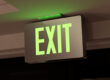
To ensure that commercial buildings provide a safe means of egress, the Life Safety Code requires emergency lighting in designated stairs, aisles, corridors, and passageways leading to an exit, as well as in exits that are not obvious or identifiable as exits. The emergency exit signage must be illuminated and visible from all directions leading to the exit. Any illuminated exit sign must have an emergency power source and automatically illuminate for at least 90 minutes when power is interrupted.
OSHA Exit Route Requirements
The Occupational Safety and Health Administration (OSHA) requirements were created to ensure healthy working conditions for persons during emergencies and to ensure that exit paths are adequately lit. OSHA regulations for lighting and marking exit routes are covered under 1910.37(b) and require, in part, that each exit route be adequately lighted so that an employee with normal vision can see along it. Each exit must be visible and marked with a sign reading “Exit.” OSHA regulations also include guidelines on the illumination of exit signs, the size of sign lettering, the placement of signage when an exit is not apparent, and the marking of doors that could be mistaken for an exit but are not. While OSHA does not require specific colors for emergency exit signs, the signage must be distinctly colored from the background.
In 1910.35, OSHA regulations provide that employers following the exit-route provisions of NFPA 101, Life Safety Code, meet OSHA’s requirements and thereby adopt NFPA 101’s guidelines. OSHA regulations also provide that those following the International Code Council’s International Fire Code satisfy OSHA’s compliance requirements.
The International Building Code (IBC)
The International Building Code (IBC) was created in 2000 and is a model building code regulated by the International Code Council. The IBC primarily pertains to fire prevention in new construction and renovation projects. Chapter 10, Means of Egress, contains subsections on illumination and covers lighting requirements for exit routes. Like the Life Safety Code, it calls for emergency exit lighting for nearly all occupancies and requires 90 minutes of active lighting when power is lost. Unlike other regulating documents, the IBC explicitly requires emergency lighting in areas not used for egress, such as fire pump rooms and fire command centers.
Your Local Authority Having Jurisdiction (AHJ)
In addition to the requirements of these three agencies, building owners must also follow the requirements of their local authority having jurisdiction (AHJ). The AHJ is the local governing body responsible for monitoring and enforcing local building and fire codes. Some large cities have unique regulations and requirements for exit signs and emergency lighting. If you are unsure of your AHJ regulations, check with your local fire marshal or building inspector.
NFPA 101 vs. OSHA vs. IBC at a Glance
| Code | NFPA 101 (Life Safety Code) | OSHA (1910.37, 1910.35) | IBC (Chapter 10) |
|---|---|---|---|
| Established | 1913 | Federal workplace safety regulation | 2000 |
| Governing body | National Fire Protection Association | Occupational Safety and Health Administration | International Code Council |
| Main focus | Life safety through building construction, protection, and occupancy features | Safe, adequately lighted exit routes for employees | Fire prevention in new construction and renovation |
| Minimum backup lighting duration | 90 minutes | Adopts NFPA 101 or International Fire Code compliance | 90 minutes |
| Notable requirement | Lighting is required at stairs, aisles, corridors, and non-obvious exits | Adequate lighting so an employee with normal vision can see the exit route, plus signage requirements | Requires emergency lighting even in non-egress areas like fire pump rooms |
Note that these three codes overlap by design. OSHA explicitly recognizes compliance with NFPA 101 or the International Fire Code as satisfying its own requirements, so most buildings are working toward the same 90-minute standard from multiple directions at once.
Frequently Asked Questions
How long must emergency exit lighting stay on during a power outage?
Emergency exit lighting must automatically illuminate for at least 90 minutes when power is interrupted, a requirement shared by NFPA 101 and the IBC.
Does OSHA require specific colors for exit signs?
No. OSHA does not require a specific color for emergency exit signage, but the sign must be clearly distinguishable from its background so it stands out.
Who enforces emergency lighting codes in my area?
Your local authority having jurisdiction (AHJ), typically a fire marshal or building inspector, enforces code compliance in addition to the requirements set by NFPA, OSHA, and the IBC. Some cities add their own unique requirements on top of these baseline codes.
Does following NFPA 101 satisfy OSHA requirements?
Yes. OSHA regulations state that employers following the exit-route provisions of NFPA 101 or the International Fire Code meet OSHA’s compliance requirements.
What areas of a building need emergency lighting besides exit paths?
The IBC requires emergency lighting in some areas not used for egress, such as fire pump rooms and fire command centers, because personnel need to reach and operate that equipment safely during an outage.
Staying Compliant
Isolite offers a full line of NFPA-, OSHA-, and IBC-compliant emergency lighting, exit signage, and combination fixtures. Isolite’s quality products are guaranteed to meet industry standards, giving you confidence in your purchase.
For a closer look at how these codes apply to specific building types and fixture grades, see Architectural vs. Commercial vs. Contractor-Grade Emergency Lighting & Exit Signs, or browse our helpful compliance guides for downloadable references.
Learn More with the Isolite webinar series.